// Rebuilding_Creativity
Branding
What Is Engagement?
 What is real engagement with content? It’s a term often used these days and most often associated with digital media. Can it really be illustrated as simply as clicking to view a video or entering a competition, how do we know if people had a real connection with the content and your brand when doing so?
To me it is more about people being moved on an emotional level, getting into their brains and giving them an association to hang your brand on. It is more about the extent to which someone retained and enjoyed what they experienced of your brand rather than simply how many times it was done. Unfortunately for us, this qualitative nature is a lot harder to deliver measurables on than quantitative. It’s this immeasurable element that can make good advertising so special. I think it’s also important to note up front that when discussing content, this could be anything from a printed ad in a newspaper to an Adshel in a bus shelter or a video on Youtube.
In an attempt to try and measurably quantify what engagement really is and how engaged people actually were, Nielsen asks to what extent the subject agrees with the content across three pillars: Funny, Emotionally Touching, Informative. Broadly speaking any piece of content would fit into one of those three categories in terms of what it is trying to achieve in terms of enagement, if it ranks on this then it’s doing it’s job. Looking at it through the lens of these three axis helps us to begin to examine how engaged people really were with the content and in what capacity. If someone can associate after the fact, a degree of connection across one of these pillars with a piece of content, I believe that shows that they were engaged by it. To try and manage this at a strategic level up front, you could for example map “Engagement Profiles” of the content based on to what extent you think they should rank across these pillars in the consumers mind. Is the content designed to be humorous and a little informative? Or simply about creating an emotional brand connection?
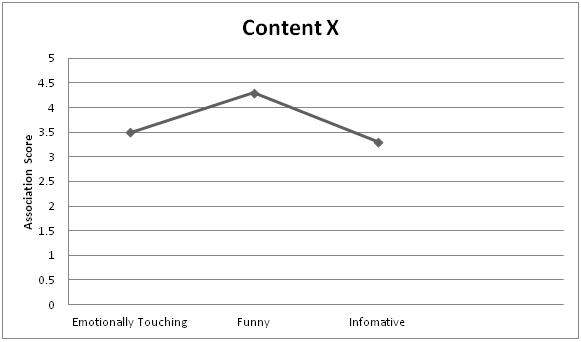
The content above is something that whilst rating quite strongly across all axis, is predominantly geared towards being funny whilst capturing an emotional connection with the brand, to a lesser extent delivering a product message. The consumer behaviour you’d hope to see from content such as this is people enjoying it, sharing their experience of it with their friends and hopefully as a by product driving brand awareness and revenue. On this note, as Clay Shirky says, “behaviour is motivation filtered through opportunity” and technology has changed the opportunity space in many ways. Now that technology has made it so easy to measure peoples immediate behaviour with online content (like, share, tweet etc), as advertisers it is all too easy to focus on measuring this as successful engagement rather than a longer term qualitative behaviour change. Not only does this ignore all other media channels it also can’t measure that emotional side of true engagement. To quote Faris Yakob,” If a piece of branded anything falls in the woods and no one Tweets about it – did it have any effect?”.
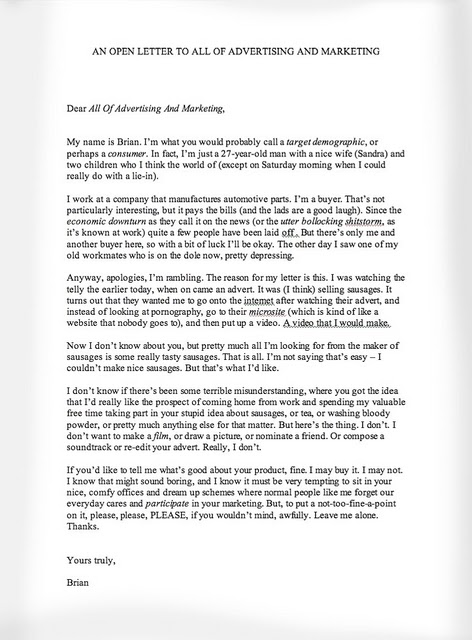
The concept that “good work works” hasn’t changed and will never do so, it will always be that the interesting content will deliver greater than usual engagement. What has changed is how people consume it and what they do with it. We must be careful not to solely focus on using these easy to access short term metrics as barometers of this and keep in mind the immeasurable emotional connections which people have with brands built over time from true engagement across all media. To end, an open letter to all advertising that has been floating around the internet for a while but I think it sums it up quite nicely.
Alex
Why Bricks and Mortar Stores Will Always Have a Role to Play

Tom Ford Store
I have recently been reading the excellent book, Why We Buy – The Science of Shopping by Paco Underhill. In it, he raised some points which really highlight to me the fact that bricks and mortar stores will always have a role to play in the retail environment. In my opinion it is unlikely that retail locations will be completely replaced by E-commerce, M-Commerce or F-Commerce, ever. To begin the discussion, lets look at defining shopping in a way that frames it as more than the simple acquisition of goods to fulfil a need.
Shopping: experiencing that portion of the world which is deemed for sale, using our senses of sight, touch, smell, taste or hearing as basis of the decision making process. (Ref. Paco Underhill)
The key message for me here is the neccessary sensory aspect is lacking in online retailing. Clearly you aren’t able to touch, smell or taste products without physically being instore. It is alot harder to truly understand the selling points of a product without being able to experience it fully. Take a look at shoppers as they wander round a store, picking things up, looking them over, taking them out of the pack, exploring and discovering. Further to this point, impulse purchases are often a result of touching and experiencing the product and indentifying the benefits it holds on the spot.
Merchandising can be just as powerful as advertising. For the most part we like to purchase based on trial and touch.
Why do we want to touch and experience things before we buy them? Firstly, for many products the tactile qualities of the product are a key selling point, such as luxury clothing from Tom Ford or manchester and linen. Even if the tactile qualities of the product don’t neccesarily require it be touched, they often still need to be experienced to get a feel for their benefits. Take technology products such as tablets, until you’ve had a go on one, flicking through some photos and articles, you really can’t tell how useful they really are.
So what else do stores offer that online retailing struggles to replicate?
Brand Experience: The instore environment can be tailored to deliver an incredibly strong brand experience, stronger then any press ad, TVC or web page. The store design and fit out, music, staff, location and surrounding stores all add up to deliver a message to people about your company and its values. Are you a high end store with exclusive location, plush interior and knowledgable staff or a discount retailer with a large store, bulk merchandising and convenient car parking? These choices alter how people perceive your company in a big way. Music also sets the tone of the environment, no self respecting teenager would shop in a store playing classical violin concertos.
Discovery: Instore you can create an environment which encourages discovery, exploring the store and experiencing the product. Sure this occurs on the internet naturally but instore it’s a much more experiential journey. Point of Sale which creates clarity of where you are in the store without oversaturating the information helps add to this. It sets the tone of the products around it but leaves the opportunity to explore the actual products in detail. For example using fashion imagery rather than text description of exact products. Sounds and smells can also be controlled, which can lead people through the store. Bakerys in supermarkets fill the store with the aroma of fresh bread, alluring you to discover and purchase the freshly baked bread.
Talking: Stores attract groups of people, if discussion can be fostered, the products begin to start selling themselves. If for example a group of girls are out looking for jeans, they will chat about the products and which looks best on each other, then perhaps running into friends and start getting their opinions also. This conversation my spread to the shoppers around them, bringing them in to the discussion. Sure it may be argued that this can be replicated to an extent online with F-Commerce (social shopping), but I don’t think it’s quite the same as the organic face to face conversation that can occur in a store environment.
Where does this leave online retailing to fit into the picture?
Obviously it will be a requirement for all businesses to offer their products online in some capacity in future if they wish to make the most of their revenue opportunities. I see it working in tandem with their retail locations. Bricks and mortar stores will be about delivering a strong brand experience for those who visit, allowing people to touch and experience the products in a controlled environment. Online retailing will then open a new avenue of sales rather than canabalising stores. Those that aren’t able to reach your physical stores perhaps due to location or lack of time, are able to purchase. It’s also great for making convenient repeat purchases on products you are already familiar with or low involvement purchases such as groceries. The convenience of being able to shop from a laptop, mobile or tablet, 24/7, 7 days a week is something people will come to expect and is an opportunty for retailers especially considering online stores don’t require staffing to be open and don’t have the same cost overheads.
Online retailing also allows retailers to take advantage of The Long Tail, a theory by Chris Anderson that there is actually more money in the “non-hits” rather than the “hits” as there is a substantially larger amount of them. It is too expensive for a bookstore for example to stock on a shelf a 15 year old book on the history of extinct moth species, filling them instead with the latest Harry Potter. However since online it costs nothing to have it available and you may actually sell one or two a year, add all these “non-hit” purchases up and you have a large revenue stream.
Technology is affecting the way retailers are doing business just as it is effecting the way we advertise to people but I don’t think there will ever be a substitute for the good old fashioned retail outlet.
If you’re interested in reading Why We Buy, you can purchase the book here: http://www.amazon.com/Why-We-Buy-Science-Shopping/dp/0684849143
Alex
 // Rebuilding_Creativity