// Rebuilding_Creativity
The Gen Z Shopper & Participation Branding
I was recently reading an article on Inside Retail about a report on “Gen Z” by Fitch which really crystallized for me a tangible indication of how the face of retail is changing and an insight into how we need to change our communication strategies to suit – in particular around the concept of Participation Branding and creating ideas that make the most of our bought, owned & earned media channels.
Gen Z, classed as those born after 1995 are hard wired to be cautious of standard marketing ploys and particularly happy to browse before making an informed purchase. A key finding from the report for me was that they demonstrated a “real gap between seeing & buying” enabled mostly by digital platforms such as social media, search or price comparison sites. Essentially the Gen Z shopper can go through a long period of what they termed “Aspirational Browsing” where they may set their sights on products far in advance of actually making a purchase. As agencies this means we need to change the way we communicate as the typical broadcast campaign based methodology is simply not going to be as effective in generating immediate sales with this audience and we need to be present across the omni-channel environment to take advantage of the long tail of our bought, owned and earned media online to ensure we get infront of them at the right time during this extended purchase funnel.
As they said in the report, “It’s all about keeping the brand and potential purchase front of mind during this extended aspirational browse period”. See the below diagram for a visual representation of this process, essentially digital platforms and connectivity enable the consumer to more easily discover, browse, buy and share then ever before.

The path to purchase for Gen Z. Source: Fitch
So how can we overcome or capture the interest of these people during this period of delayed gratification? We have to make sure that our messaging is spread across our digital brand ecosystem through our bought, owned & earned channels so that whilst we will have a big spike in activity across our campaign period, the content lives on so it will be there when and where our Gen Z consumer is browsing or ready to purchase. I recently attended a talk in which the idea of “Participation Branding” was presented, which reflects how we can change our communication strategies to suit this extended period of digital browsing. Participation branding was defined as the below:
“How a brand engages and behaves with consumers across channels and over time to earn their attention and participation through motivating stories and experiences.”
By weaving digital experiences into our campaigns we create an element of interactivity for our ideas which encourages participation by these digitally enabled shoppers. This means that we can actually harness this new shopping behaviour as a positive for our brands and use it spread our message across our brand ecosystem by engaging them through this period of aspirational browsing. In terms of our approach it’s simply just adding another set of tools to our arsenal on top of brand marketing & direct response in the form of social influence marketing:
|
Participation Branding |
||
|
Brand Marketing
|
Direct Response Marketing |
Social Influence Marketing |
By ensuring we use media neutral ideas that propogate digital content and experiences across our bought, owned & earned channels, we start to rally participation and engagement in the brand which builds a digital trail of content or “brand ecosystem” over time. This allows us to take advantage of the long tail of this content by having it live on after the campaigns which means it will be there in the consideration set when the Gen Z shopper is browsing or comparing to make sure we are top of mind – whether it’s during the campaign period or months after when they are looking to purchase. See below a chart from the same presentation which shows how the spikes of campaigns help to build our overall ecosystem over time.
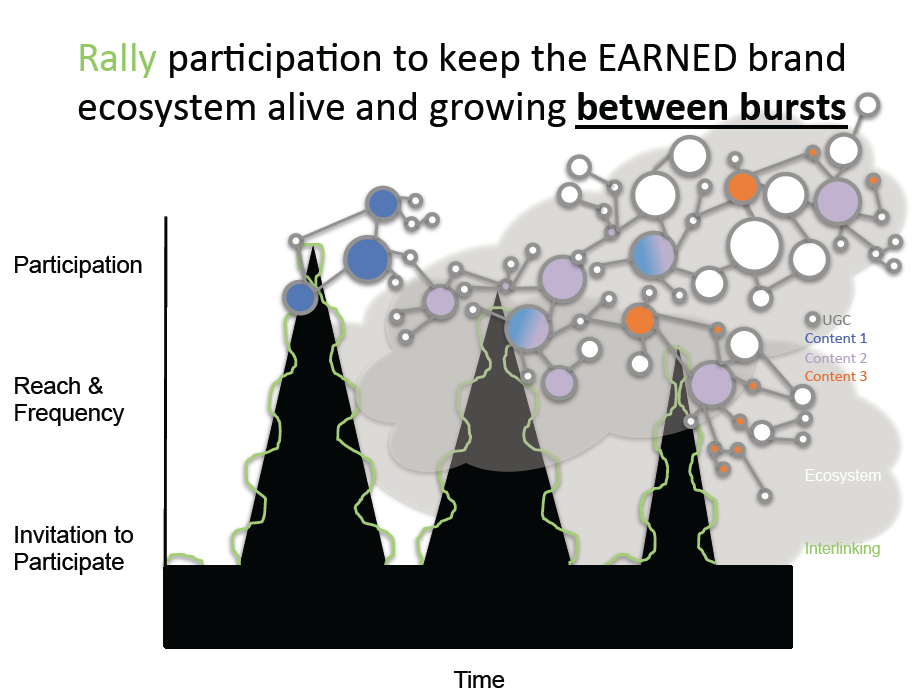
Source: Heather Albrecht of Digital Connections Pty Ltd http://www.digitalconnec6ons.com.au
It’s an exciting time to be in both the retail and communications businesses, the way people consume media and even the way they browse and shop is changing as fast as technology allows. However as long as we continue to create engaging ideas that get infront of the right people at the right time, we will continue to see results – some things never change!
Author: Alex Leece
What Is Engagement?
 What is real engagement with content? It’s a term often used these days and most often associated with digital media. Can it really be illustrated as simply as clicking to view a video or entering a competition, how do we know if people had a real connection with the content and your brand when doing so?
To me it is more about people being moved on an emotional level, getting into their brains and giving them an association to hang your brand on. It is more about the extent to which someone retained and enjoyed what they experienced of your brand rather than simply how many times it was done. Unfortunately for us, this qualitative nature is a lot harder to deliver measurables on than quantitative. It’s this immeasurable element that can make good advertising so special. I think it’s also important to note up front that when discussing content, this could be anything from a printed ad in a newspaper to an Adshel in a bus shelter or a video on Youtube.
In an attempt to try and measurably quantify what engagement really is and how engaged people actually were, Nielsen asks to what extent the subject agrees with the content across three pillars: Funny, Emotionally Touching, Informative. Broadly speaking any piece of content would fit into one of those three categories in terms of what it is trying to achieve in terms of enagement, if it ranks on this then it’s doing it’s job. Looking at it through the lens of these three axis helps us to begin to examine how engaged people really were with the content and in what capacity. If someone can associate after the fact, a degree of connection across one of these pillars with a piece of content, I believe that shows that they were engaged by it. To try and manage this at a strategic level up front, you could for example map “Engagement Profiles” of the content based on to what extent you think they should rank across these pillars in the consumers mind. Is the content designed to be humorous and a little informative? Or simply about creating an emotional brand connection?
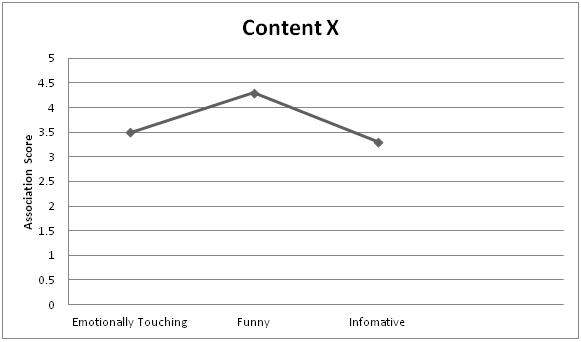
The content above is something that whilst rating quite strongly across all axis, is predominantly geared towards being funny whilst capturing an emotional connection with the brand, to a lesser extent delivering a product message. The consumer behaviour you’d hope to see from content such as this is people enjoying it, sharing their experience of it with their friends and hopefully as a by product driving brand awareness and revenue. On this note, as Clay Shirky says, “behaviour is motivation filtered through opportunity” and technology has changed the opportunity space in many ways. Now that technology has made it so easy to measure peoples immediate behaviour with online content (like, share, tweet etc), as advertisers it is all too easy to focus on measuring this as successful engagement rather than a longer term qualitative behaviour change. Not only does this ignore all other media channels it also can’t measure that emotional side of true engagement. To quote Faris Yakob,” If a piece of branded anything falls in the woods and no one Tweets about it – did it have any effect?”.
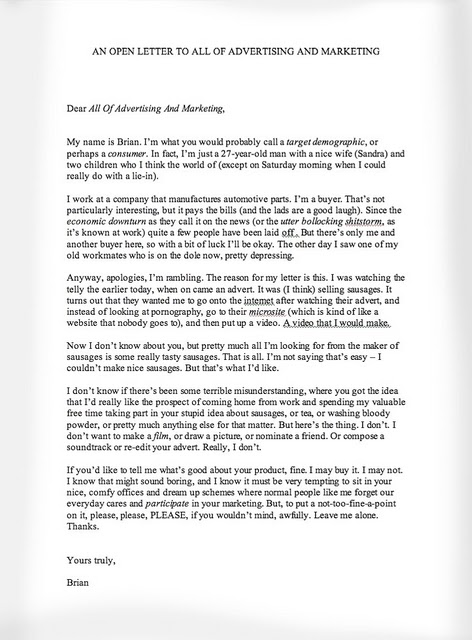
The concept that “good work works” hasn’t changed and will never do so, it will always be that the interesting content will deliver greater than usual engagement. What has changed is how people consume it and what they do with it. We must be careful not to solely focus on using these easy to access short term metrics as barometers of this and keep in mind the immeasurable emotional connections which people have with brands built over time from true engagement across all media. To end, an open letter to all advertising that has been floating around the internet for a while but I think it sums it up quite nicely.
Alex
Big Data & In Memory Computing

BT Tower - London - A Monument To The Broadcast Era
Big Data is a term coined to describe the data deluge we are currently experiencing. It’s no secret that we are living in a technology driven society that generates an ever increasing amount of data as we go about our daily lives. “Always on” is a term that is often heard and more often then not, when we are “on” we are creating data about ourselves, our likes and our dislikes, our network of friends both professional and social, and even our travel habits. At the same time, businesses must also retain more and more information to manage themselves more efficiently across the board. In tough economic times there is an ever increasing recognition that organisations must use every single resource at their disposal to get ahead. This results in information and data that once might have been given little attention is now seen as worth its weight in gold if any perceived value can be derived from it.
Looking at the sources of this data, to start with there is of course the sales, operational and customer data that the business collects. On top of this there’s social media data from the likes of Facebook and Twitter including information around friend groups, likes/dislikes and sentiment analysis. There’s web search data, with transactional information or online customer reviews. There’s also data generated by location-based services and data from sensors, moniters and GPS embedded in a growing array of products from vehicles to appliances. I believe if we as advertisors can offer solutions to our clients of how we can process and utilise the growing amount of data available to help inform creative business solutions we could offer real value. To quote a recent Financial Times article
“The challenges are two-fold: First, to recognize the value of big data in mining customer needs and desires, and second, to devise a data management strategy that integrates big data into the front end of the innovation pipeline.”
So how do businesses harness all the data that is being created and use it to inform their strategy and decision making? The challenge here is being able to process large amounts of data at speeds that make it useful. It’s very difficult to really make use of data in business decisions on an ongoing basis when it takes weeks to gather and process. Large software powerhouses such as SAP & Oracle have been bringing new tools to market for businesses to help solve this problem. In memory computing software is designed so organisations can analyse vast quantities of data in near real time across many sources. Essentially in-memory computing takes advantage of a better understanding of how data is formed and housed and the ever decreasing price of memory (discussed in my Technology vs Advertising post). Instead of housing data on a hard drive, data is stored in a computers memory. Therefore, when it needs to be analysed it is available in near real time. This increased power and speed also means that the computers can handle more unstructured data, important when data can come from so many different sources. On the back of this there would need to be a process for managing and delivering the data in an efficient manner and most importantly, in a way that is easy to understand and glean insights from.
Whilst I think caution must be taken not to let our ability to measure granular details bog down the creative process, at the end of the day, the more you know about your customers and can integrate those insights into your business strategies the more likely they are to improve revenue, margins and market share. Who wouldn’t want that leg up over the competition?
Alex
 // Rebuilding_Creativity