// Rebuilding_Creativity
Faris Yakob
What Is Engagement?
 What is real engagement with content? It’s a term often used these days and most often associated with digital media. Can it really be illustrated as simply as clicking to view a video or entering a competition, how do we know if people had a real connection with the content and your brand when doing so?
To me it is more about people being moved on an emotional level, getting into their brains and giving them an association to hang your brand on. It is more about the extent to which someone retained and enjoyed what they experienced of your brand rather than simply how many times it was done. Unfortunately for us, this qualitative nature is a lot harder to deliver measurables on than quantitative. It’s this immeasurable element that can make good advertising so special. I think it’s also important to note up front that when discussing content, this could be anything from a printed ad in a newspaper to an Adshel in a bus shelter or a video on Youtube.
In an attempt to try and measurably quantify what engagement really is and how engaged people actually were, Nielsen asks to what extent the subject agrees with the content across three pillars: Funny, Emotionally Touching, Informative. Broadly speaking any piece of content would fit into one of those three categories in terms of what it is trying to achieve in terms of enagement, if it ranks on this then it’s doing it’s job. Looking at it through the lens of these three axis helps us to begin to examine how engaged people really were with the content and in what capacity. If someone can associate after the fact, a degree of connection across one of these pillars with a piece of content, I believe that shows that they were engaged by it. To try and manage this at a strategic level up front, you could for example map “Engagement Profiles” of the content based on to what extent you think they should rank across these pillars in the consumers mind. Is the content designed to be humorous and a little informative? Or simply about creating an emotional brand connection?
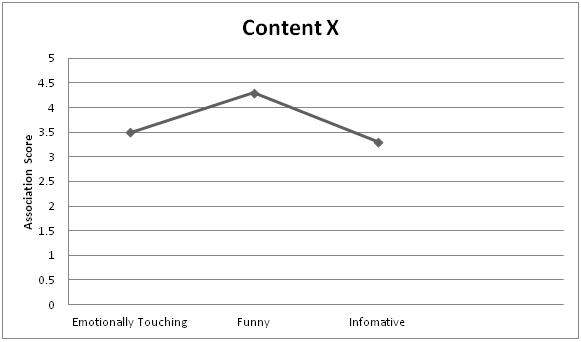
The content above is something that whilst rating quite strongly across all axis, is predominantly geared towards being funny whilst capturing an emotional connection with the brand, to a lesser extent delivering a product message. The consumer behaviour you’d hope to see from content such as this is people enjoying it, sharing their experience of it with their friends and hopefully as a by product driving brand awareness and revenue. On this note, as Clay Shirky says, “behaviour is motivation filtered through opportunity” and technology has changed the opportunity space in many ways. Now that technology has made it so easy to measure peoples immediate behaviour with online content (like, share, tweet etc), as advertisers it is all too easy to focus on measuring this as successful engagement rather than a longer term qualitative behaviour change. Not only does this ignore all other media channels it also can’t measure that emotional side of true engagement. To quote Faris Yakob,” If a piece of branded anything falls in the woods and no one Tweets about it – did it have any effect?”.
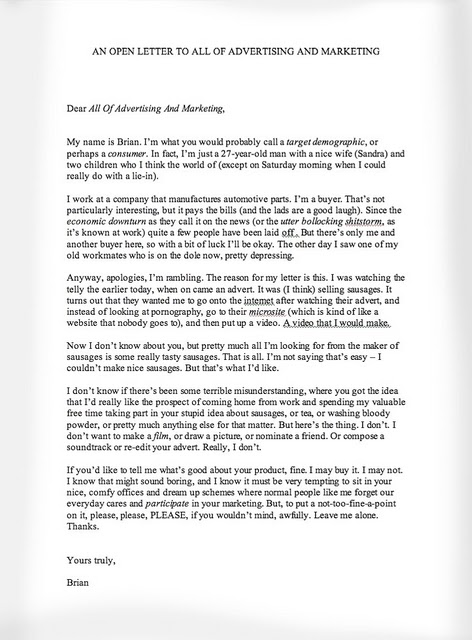
The concept that “good work works” hasn’t changed and will never do so, it will always be that the interesting content will deliver greater than usual engagement. What has changed is how people consume it and what they do with it. We must be careful not to solely focus on using these easy to access short term metrics as barometers of this and keep in mind the immeasurable emotional connections which people have with brands built over time from true engagement across all media. To end, an open letter to all advertising that has been floating around the internet for a while but I think it sums it up quite nicely.
Alex
Cultural Latency – Easy Come, Easy Go

A 2009 study has found that the fall of an item’s popularity mirrors its rise to popularity, so that items that become popular faster also die out faster, which is demonstrated by name trends. Image caption: Berger and Le Mens. ©2009 PNAS
It seems like everything is becoming more disposable these days. As we become more connected and have always on access to content that we can engage with and distribute in real time, what effect does this have on the life cycle of content?
Previously creating content was the domain of specialists and distributing it was restricted to those with money and corporate backing through well established networks. Mail was delivered in days rather than seconds and news content was printed and delivered to your door. Even music took time to distribute through retail outlets on vinyl or CD. Now just about anyone with a PC and an internet connection can create and rapidly share their ideas and content. I was reading over Faris Yakob’s post in which he raised an interesting point about what he termed Cultural Latency, in that there is a correlation between
“the amount of time it takes to distribute something, and the amount of time it takes for that thing to have an effect, and consequently the amount of time that thing stays relevant and interesting.”
Essentially research has found evidence to back up the saying, easy come, easy go. A 2009 study found that a fall of an item’s popularity seems to mirror that of it’s rise (see graph above). They discovered this in studying the popularity of names in France & US over the last 100 years. They hypothesize that whilst there is no mathematical reason behind this phenomenon, it is driven by people’s beliefs creating the reality, probably stemming from the fact that it gets to a point where people don’t like to be thought to follow the mainstream. It is an example of the interrelationship of how psychological processes can shape culture and that culture can shape thought processes.
Now that digital technology is reducing the friction points within any given distribution system, it is making them more efficient and is causing this effect to become quite evident in the life span of content. Content can spread and become popular faster then ever before, I guess we’d call this “going viral”. This has the effect of creating much faster feedback loops, information is delivered and consumed faster, which triggers more effects in quick succession. This rapid rise has the flow on effect of potentially leading to much faster cultural decay. Just take music for example, you can see bands come from nowhere with a manufactured hit then just as quickly disappear off the radar.
So what does this all mean? It certainly raises the case for slow and steady organic growth. Perhaps it’s not always better to go after a meteoric rise to fame but to consider the option of growing at a slower pace. Obviously this would depend on the content or objectives behind the strategy of the campaign but an interesting point to consider when considering a brand or content strategy.
Alex
 // Rebuilding_Creativity