// Rebuilding_Creativity
planning
City Life – A Digital Transformation?
 I recently read an article on the FT by Simon Kupor entitled The App Of Life, which discussed the interesting effect that technology has on urban living. It’s no secret that technology has always affected how we live and the town planning that surrounds it. The industrial revolution led to the creation of densely populated working areas and the mass production of vehicles created greater sprawl, enabling the typical suburbian lifestyle.
When the internet came about and people were able to connect and share information remotely, there was talk of the demise of cities. Why would you want to live in densely populated areas and work in large offices when you can do so from the comfort of your own home in the peaceful surroundings of the countryside? I feel that whilst this sounds good in theory, in practice there is always value in proximity. In a business sense, the internet is no replacement for being around people and bouncing ideas off them in person. For more on the virtue of proximity, see my post The Value Of Proximity. I don’t think that digital connectivity will see the demise of the city, quite the contrary, I agree with Simon Kupor in that I think it will enable them to be better places to live thereby helping them to grow.
This effect can be seen already, mobile technology and smart phones are a perfect example of this. I’m someone who (through no fault of their own) is severely navigationally impaired, paper bags pose a challenge. This problem has thankfully been completey resolved for me by being able to punch an address into my phone, then get GPS co-ordinates of where I am and where I need to go. This makes navigating the complex road network of any city a breeze, making it more pleasant and efficient to get around. Further to this, if I need to find any kind of service, all I need to do is look it up on my phone and it tells me all the options around me, allowing me to make the most of the cities retail and service offerings. Plugging this in to the social graph means I’m never alone as I can find out where my friends are at any given time.
The next step is people using technology and data to help run their cities. We’ve seen the social graph with Facebook, interest graph with Twitter what could happen if we had an entire city grid open to plug in to? With an open graph style system governments could assist us to manage water, transport, parking or power. Imagine being able to remotely check your water or power consumption from your phone and adjust accordingly. Even just being able to find out where parking spaces were available would be a huge step in efficiency! Interestingly the article points out that Dublin has opened data on everything from water use to transport in the hopes that developers will devise opportunities to use this to improve city design and living. To quote the article, “We’re starting to see almost an “open-source design” of cities, says Ratti.”
Whilst the lure of the country side and an internet connection still remains, I think digital technology will enable city life to be more efficient and enjoyable then ever before. This will naturally lead to the continuation of their draw for people and their growth. If you need any proof of this just take a look at the ever increasing rate that we are building Skyscrapers (and their burgeoning height). We seem to be building up rather than out, I’m relieved my phone will tell me which floor I’m on.
Alex
Reference:
http://www.ft.com/intl/cms/s/2/36eaf488-b5b4-11e1-ab92-00144feabdc0.html#axzz1xwmYsZWZ
By Simon Kupor
What Is Engagement?
 What is real engagement with content? It’s a term often used these days and most often associated with digital media. Can it really be illustrated as simply as clicking to view a video or entering a competition, how do we know if people had a real connection with the content and your brand when doing so?
To me it is more about people being moved on an emotional level, getting into their brains and giving them an association to hang your brand on. It is more about the extent to which someone retained and enjoyed what they experienced of your brand rather than simply how many times it was done. Unfortunately for us, this qualitative nature is a lot harder to deliver measurables on than quantitative. It’s this immeasurable element that can make good advertising so special. I think it’s also important to note up front that when discussing content, this could be anything from a printed ad in a newspaper to an Adshel in a bus shelter or a video on Youtube.
In an attempt to try and measurably quantify what engagement really is and how engaged people actually were, Nielsen asks to what extent the subject agrees with the content across three pillars: Funny, Emotionally Touching, Informative. Broadly speaking any piece of content would fit into one of those three categories in terms of what it is trying to achieve in terms of enagement, if it ranks on this then it’s doing it’s job. Looking at it through the lens of these three axis helps us to begin to examine how engaged people really were with the content and in what capacity. If someone can associate after the fact, a degree of connection across one of these pillars with a piece of content, I believe that shows that they were engaged by it. To try and manage this at a strategic level up front, you could for example map “Engagement Profiles” of the content based on to what extent you think they should rank across these pillars in the consumers mind. Is the content designed to be humorous and a little informative? Or simply about creating an emotional brand connection?
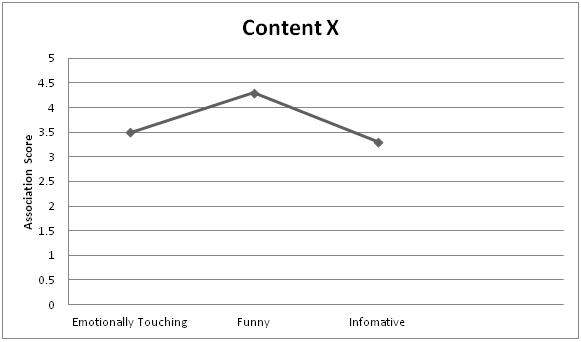
The content above is something that whilst rating quite strongly across all axis, is predominantly geared towards being funny whilst capturing an emotional connection with the brand, to a lesser extent delivering a product message. The consumer behaviour you’d hope to see from content such as this is people enjoying it, sharing their experience of it with their friends and hopefully as a by product driving brand awareness and revenue. On this note, as Clay Shirky says, “behaviour is motivation filtered through opportunity” and technology has changed the opportunity space in many ways. Now that technology has made it so easy to measure peoples immediate behaviour with online content (like, share, tweet etc), as advertisers it is all too easy to focus on measuring this as successful engagement rather than a longer term qualitative behaviour change. Not only does this ignore all other media channels it also can’t measure that emotional side of true engagement. To quote Faris Yakob,” If a piece of branded anything falls in the woods and no one Tweets about it – did it have any effect?”.
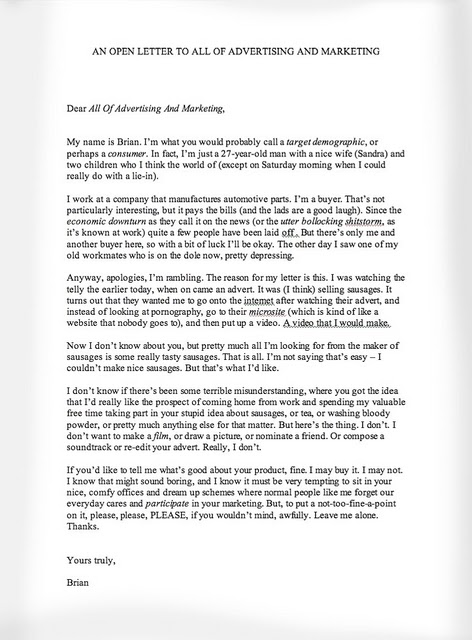
The concept that “good work works” hasn’t changed and will never do so, it will always be that the interesting content will deliver greater than usual engagement. What has changed is how people consume it and what they do with it. We must be careful not to solely focus on using these easy to access short term metrics as barometers of this and keep in mind the immeasurable emotional connections which people have with brands built over time from true engagement across all media. To end, an open letter to all advertising that has been floating around the internet for a while but I think it sums it up quite nicely.
Alex
How To Make Stuff
 Partially to share my thoughts and partially to force myself to organise them, I thought I’d share my take on how to make stuff based on the experiences I’ve had so far in driving digital work.
Now this is not a new concept, but I find the 4 D’s of web design are a great basis for looking at the process involved in any digital based project and can be applied to anything from a website to a mobile app.
Discovery: Requirements & Flat Plan
Collaboration. I find the best first step is to get everyone involved in the project in some way, shape or form into a room with a whiteboard and a marker. Begin by ensuring everyone is on the same page around the core of the idea then start discussing and drawing. Start by wireframing out the core components of the idea with boxes and arrows linking them all together to show the process flow. From my experience just going through the process of doing this will help the idea to become clearer as to how it all fits together. As a thought process, consider, what directs peoples awareness towards the idea, how do they experience it, what do they do to engage with it, how do they share it and what closes the loop and keeps them coming back either to stores or the experience itself.
Design: Wireframes & Design
After the general concept has been discussed and the requirements of the project has been agreed upon, the next step is to work on wireframes and design concepts. Wireframes have evolved over time and are becoming more and more visual, even interactive. There are a number of different pieces of software out there now which help to create and visualize wireframes, making them far quicker and easier to put together. Not only that but they can be done in a number of different ways from prototypes in keynote to grey box layouts. There is a fine line between visual and functional and how functional you need to make them.
Once the wireframes are put together, it’s time to look at the design. I find it best to visually design just the key elements with a few concept options at first to get the direction approved. Once this step is complete, it is then quick to go through and design each element of the approved wireframe with the approved design.
Development: Content, Front & Back End
The first step here is asset collection, it’s crucial for the team developing the product to have all the assets they require as soon as possible to keep the process going. In terms of back end, look to leverage previous projects for functionality to speed up development time and reduce costs.
Coming back to the concept of collaboration again, digital projects really require cross disciplinary teams. I’ve found this to be a real team process and not only just in terms of the digital team with front and back end development. You’ll often need creative direction and content input from across the agency also from, TVP, Photo Studio and Mac Ops. It’s all about finding the most efficient place to put the specific task.
In terms of signing off the development, look towards an iteratitve process. It’s simply not possible to present a first development stage that is perfect, so present a first build, second build, taking feedback and improving as you move towards the deadline.
Delivery: Testing, Launch & Post Launch
Before the project goes live, if the time allows, I definitely recommend user testing. It’s always surprising to see what the users will comment on and how they experience the journey. It can often be vastly different to what you imagine and some of the functionality that may seem logical through development may be shown to not be quite so.
Unlike traditional channels, once a digital project is live, it isn’ t the last you’ll see of it. Often there will be teething issues to resolve and you’ll need to keep an eye on tracking & feedback against KPIs. As a side note, look to bake in tracking and analysis features and consider hosting environment and how best to keep it running fast.
As a thought point to end on, perhaps good enough is actually good enough in the digital world. This process is not an exact science and it takes trial and error to really learn and push the boundaries. Being fast and agile like a tech start up really helps to drive this sort of work and unlike other mediums it really lends itself to being iterative.
Alex
 // Rebuilding_Creativity