// Rebuilding_Creativity
research
Big Data & Creativity – The Uber Case Study
 Are we seeing the beginning of the rise of the machines? I recently went to a talk on big data that looked at Uber as a case study example of applying big data to business and this was the first thought that sprang to mind. Essentially Uber is valued so highly not because it provides cool taxis but because it is a big data company that applies big data to automate and optimise the Taxi business. We as agencies can learn alot from Uber in terms of being creative with data, however caution must be taken to avoid big data blindness and ensure proper human analysis is applied to it.
As a core insight, the guys at Uber worked out that the number one predictor of satisfaction with taxi companies wasn’t necessarily how long it actually takes the car to arrive but how long it takes perceptually based on the customers situation. For example you may expect a car to take 5 minutes to get to you in the middle of the day in the city, however 15 minutes if you were out in the suburbs – you adjust your expectations based on your situation. With this in mind they were then able to be creative with data in terms of optimising supply and demand for this key metric with factors such as the car type and quantity, the drivers, weather, traffic lights or sense of time varying depending on location (city vs country). They don’t neccessarily send the geographically closest car but the car that can get their the fastest perceptually to optimise their supply chain. All this happens in the background and creates a seamless experience for the customer, essentially Uber removes the need for a human on the phone as a dispatcher with a more efficient automated system. This is why many taxi drivers are up in arms about Uber as it really takes the human element out of their jobs, dispatchers are no longer required and they are given a predetermined route to drive which essentially turns them into slaves to the computer and can impact on their income.
Data and automation are certainly not a replacement for humans in all situations though, it can help guide us but it still requires a human to make sense of it and apply it. The reason proposed for this is that ultimately big data is human so it requires a human to combine, interpret and apply it in a meaningful way. Just as we would expect with any form of research, simply because there is lots of it it doesn’t mean that it is statistically accurate without analysis. Take Google Flu Trends as an example, launched in 2008, Google attempted to make accurate predictions about flu activity based on aggregating search queries. Initially the model seemed to predict with accuracy however the cracks started to show when the estimate for the 2011-12 flu season was more than 50 percent higher than the cases reported by the Centers for Disease Control and Prevention. The danger that this highlights, is that it’s easy to fall into the trap of big data blindness where simply because there is lots of it we assume its statistically accurate and make poor assumptions without applying proper analysis of the results. For example, people making flu-related Google searches may not know much about how to tell if they actually have it or not, increasing false positive search queries. This is not to say big data isn’t useful, it just needs to have the same rigour applied to it as any other form of data.
With all this in mind, for us as agencies big data is great as it can help us do away with putting all our emphasis on the typical “Focus Group” as we can interpret other factors of behaviour. It can also help feed our understanding of our market and discovering peoples “secret self” – their unconscious motivations that drive their behaviour in situations which can be difficult to draw out in typical research as people tend to act differently when they are being watched. Much like Uber, we need to be creative with how we approach problems and data as data can help us serve customers better by optimising and automating their experience. Data can also help us understand our customers better then ever before and help us to create messaging that resonates with their unconscious motivations, helping to remove barriers to consumption. The machines still need us, for now at least!
Author: Alex Leece
What Is Engagement?
 What is real engagement with content? It’s a term often used these days and most often associated with digital media. Can it really be illustrated as simply as clicking to view a video or entering a competition, how do we know if people had a real connection with the content and your brand when doing so?
To me it is more about people being moved on an emotional level, getting into their brains and giving them an association to hang your brand on. It is more about the extent to which someone retained and enjoyed what they experienced of your brand rather than simply how many times it was done. Unfortunately for us, this qualitative nature is a lot harder to deliver measurables on than quantitative. It’s this immeasurable element that can make good advertising so special. I think it’s also important to note up front that when discussing content, this could be anything from a printed ad in a newspaper to an Adshel in a bus shelter or a video on Youtube.
In an attempt to try and measurably quantify what engagement really is and how engaged people actually were, Nielsen asks to what extent the subject agrees with the content across three pillars: Funny, Emotionally Touching, Informative. Broadly speaking any piece of content would fit into one of those three categories in terms of what it is trying to achieve in terms of enagement, if it ranks on this then it’s doing it’s job. Looking at it through the lens of these three axis helps us to begin to examine how engaged people really were with the content and in what capacity. If someone can associate after the fact, a degree of connection across one of these pillars with a piece of content, I believe that shows that they were engaged by it. To try and manage this at a strategic level up front, you could for example map “Engagement Profiles” of the content based on to what extent you think they should rank across these pillars in the consumers mind. Is the content designed to be humorous and a little informative? Or simply about creating an emotional brand connection?
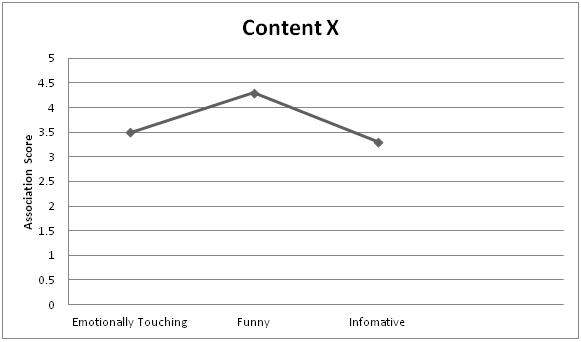
The content above is something that whilst rating quite strongly across all axis, is predominantly geared towards being funny whilst capturing an emotional connection with the brand, to a lesser extent delivering a product message. The consumer behaviour you’d hope to see from content such as this is people enjoying it, sharing their experience of it with their friends and hopefully as a by product driving brand awareness and revenue. On this note, as Clay Shirky says, “behaviour is motivation filtered through opportunity” and technology has changed the opportunity space in many ways. Now that technology has made it so easy to measure peoples immediate behaviour with online content (like, share, tweet etc), as advertisers it is all too easy to focus on measuring this as successful engagement rather than a longer term qualitative behaviour change. Not only does this ignore all other media channels it also can’t measure that emotional side of true engagement. To quote Faris Yakob,” If a piece of branded anything falls in the woods and no one Tweets about it – did it have any effect?”.
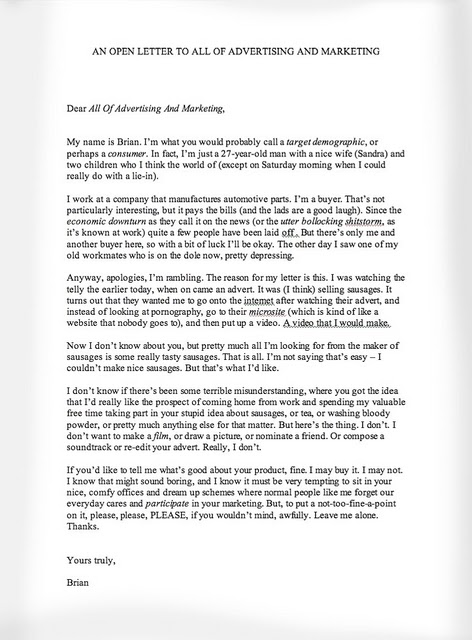
The concept that “good work works” hasn’t changed and will never do so, it will always be that the interesting content will deliver greater than usual engagement. What has changed is how people consume it and what they do with it. We must be careful not to solely focus on using these easy to access short term metrics as barometers of this and keep in mind the immeasurable emotional connections which people have with brands built over time from true engagement across all media. To end, an open letter to all advertising that has been floating around the internet for a while but I think it sums it up quite nicely.
Alex
 // Rebuilding_Creativity