// Rebuilding_Creativity
Strategy
What Is Engagement?
 What is real engagement with content? It’s a term often used these days and most often associated with digital media. Can it really be illustrated as simply as clicking to view a video or entering a competition, how do we know if people had a real connection with the content and your brand when doing so?
To me it is more about people being moved on an emotional level, getting into their brains and giving them an association to hang your brand on. It is more about the extent to which someone retained and enjoyed what they experienced of your brand rather than simply how many times it was done. Unfortunately for us, this qualitative nature is a lot harder to deliver measurables on than quantitative. It’s this immeasurable element that can make good advertising so special. I think it’s also important to note up front that when discussing content, this could be anything from a printed ad in a newspaper to an Adshel in a bus shelter or a video on Youtube.
In an attempt to try and measurably quantify what engagement really is and how engaged people actually were, Nielsen asks to what extent the subject agrees with the content across three pillars: Funny, Emotionally Touching, Informative. Broadly speaking any piece of content would fit into one of those three categories in terms of what it is trying to achieve in terms of enagement, if it ranks on this then it’s doing it’s job. Looking at it through the lens of these three axis helps us to begin to examine how engaged people really were with the content and in what capacity. If someone can associate after the fact, a degree of connection across one of these pillars with a piece of content, I believe that shows that they were engaged by it. To try and manage this at a strategic level up front, you could for example map “Engagement Profiles” of the content based on to what extent you think they should rank across these pillars in the consumers mind. Is the content designed to be humorous and a little informative? Or simply about creating an emotional brand connection?
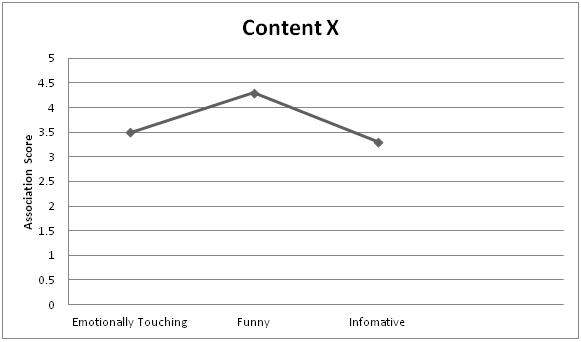
The content above is something that whilst rating quite strongly across all axis, is predominantly geared towards being funny whilst capturing an emotional connection with the brand, to a lesser extent delivering a product message. The consumer behaviour you’d hope to see from content such as this is people enjoying it, sharing their experience of it with their friends and hopefully as a by product driving brand awareness and revenue. On this note, as Clay Shirky says, “behaviour is motivation filtered through opportunity” and technology has changed the opportunity space in many ways. Now that technology has made it so easy to measure peoples immediate behaviour with online content (like, share, tweet etc), as advertisers it is all too easy to focus on measuring this as successful engagement rather than a longer term qualitative behaviour change. Not only does this ignore all other media channels it also can’t measure that emotional side of true engagement. To quote Faris Yakob,” If a piece of branded anything falls in the woods and no one Tweets about it – did it have any effect?”.
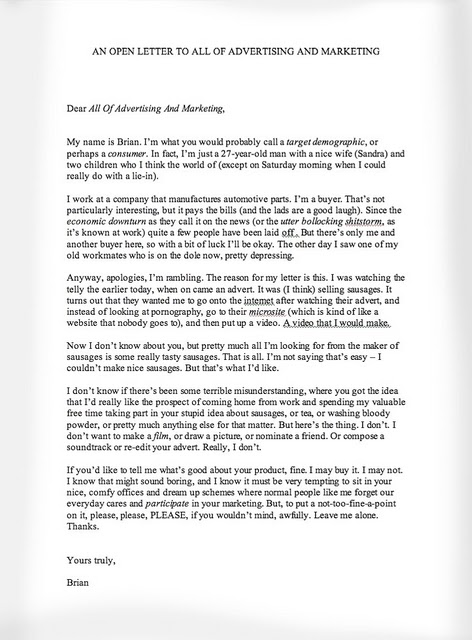
The concept that “good work works” hasn’t changed and will never do so, it will always be that the interesting content will deliver greater than usual engagement. What has changed is how people consume it and what they do with it. We must be careful not to solely focus on using these easy to access short term metrics as barometers of this and keep in mind the immeasurable emotional connections which people have with brands built over time from true engagement across all media. To end, an open letter to all advertising that has been floating around the internet for a while but I think it sums it up quite nicely.
Alex
Newspapers – Product & Positioning
 I was recently reading an article in Monocle magazine about a newspaper in Norway, Dagens Naringsliv, http://www.dn.no/ which targets the premium end of the news market with their printed editions with thorough, quality, investigative journalism whilst utilising their website & tablet editions for breaking and up to the minute news & comment. Could this be the future for newspapers? Will printed paper stand for quality like it once did when the internet and digital devices are ubiquitous? In my opinion we are seeing this trend to an extent with magazines already.
It’s no new concept however that in advertising and media we need to look beyond just the product itself as a basis for our strategy. In our over saturated & communicated market, this is no longer enough. Even if we have the best product we now need to look at how the product is positioned in the minds of the receivers/consumers to really find our space in the market. Technology and the internet are forcing newspapers into a transition phase where their old model of being a printed advertising delivery system where journalism takes a back seat is rapidly becoming obsolete. Readership is dropping as people turn to the internet for their daily news rather than the traditional printed edition.
Could a new product & positioning strategy perhaps help to both revive the printed edtions and innovate the business model into the future? With some clever positioning and quality content this could be the case. I’m sure there will always be people willing to pay for quality journalism on a tangible medium such as paper, especially if we can make people feel more sophisticated for doing so. Let’s face it, we by nature are tactile creatures and there is something about the feeling of a good quality paper stock in your hands that no amount of digital technology can replicate.
So how could a newspaper go about doing this? For a starters it would most likely take a refresh of brand design and some self promotion.
For the printed editions the below points could be considered:
- Improve the quality of the content (look at longer form journalism, perhaps investigative content & content with strong editorial influence)
- Improve the quality of the paper stock
- Consider the distribution quantity (perhaps reducing the printed circulation and targeting specific geographic regions to control costs)
- Consider the distribution channels (could the channels be more carefully considered to portray a premium image?)
- Increase the price to reflect a premium pricing strategy
Then, back it up with an “always on” site which can be viewed across multiple devices from laptops to tablets or mobile. Content here could be up to the minute, with far less editorial control & could cover a wider variety of stories & commentary. As you compete on a global scale online, keeping content curated to the region your printed in would most likely serve best against competition from strong international news powerhouses. Paywalls should most likely become the norm for certain content here also.
All this aside, the biggest challenge facing the industry is that with the web it is impossible to monetise to the same extent as print since the advertising space isn’t as valuable. Unfortunately for them, I doubt this hurdle will ever be able to be overcome, they may simply never be as profitable as they once were and the focus must go back to quality content. As it should be.
Alex
Gareth Kay on How To Make Strategy More Useful
 I last night attended a talk by Gareth Kay (@garethk) from Goodby, Silverstein & Partners on how to make strategy more useful. Thought I’d post up my rough notes of key points he talked to.
I think the key take aways for me were that creative work is becoming more effective work over time as technology and social networks create an environment where the message of creative campaigns gets amplified. Secondly, in order for us to make strategy to drive this creativity more useful, we need to create better problems. It’s definitely a case of more creative work in is conducive to more creative work out.
Notes below:
Creative work more than ever equals effective work. Technology (being connected) & social networks amplify the message of creative campaigns. It drives business and fame plus is more efficient over time.
How to make strategy more useful:
1 Define better problems – not just “sell more” or “raise awareness”. Interesting problem provides the foundation for interesting creative. “make 999/1000 people not want to be a police officer” (a problem for creative regarding recruiting police officers).
2 Be in the service of people
3 Be a bit less visible – less interruption , visibility through invisibility, don’t necessarily expect people to come to you – be part of their day.
4 Break the tyranny of messaging – “what should we say”, consider doing things rather than saying things.
5 Look at the way we work – big ideas aren’t necessarily so big anymore, more small bets can create momentum. Consider an “R&D budget”, iteration, experimentation vs planning, cost of failure is less, agile cross discipline teams, can’t be perfect, improvising towards a simple goal. Embrace change.
Alex
 // Rebuilding_Creativity